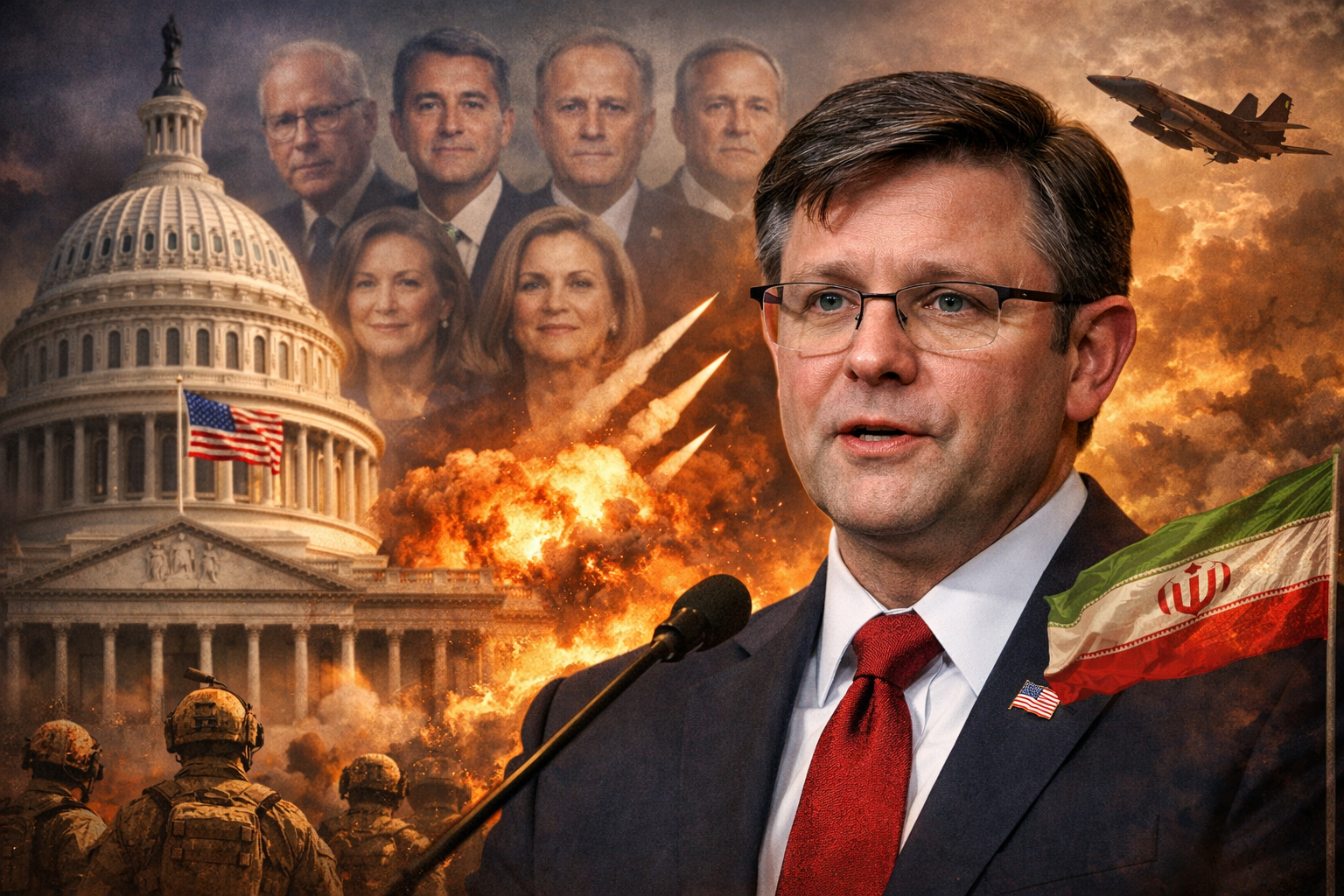
U.S. House Speaker Mike Johnson said the Trump administration briefed the “Gang of Eight” earlier in the week on the possibility that the United States might take military action against Iran. Johnson added that Secretary of State Marco Rubio provided follow-up updates and that he plans to stay in close contact with the White House as events unfold.
The comment matters because it sits at the intersection of two pressures that often collide in fast-moving crises: the executive branch’s desire to move quickly and protect sensitive intelligence, and Congress’s constitutional role in authorizing war and overseeing national security policy. In practice, administrations often rely on limited, classified briefings to top leaders when they expect escalation, especially when timing and operational security drive decisions.
What Johnson said and what it signals
Johnson framed the briefing as detailed and timely, which suggests the administration wanted to show it did not shut Congress out completely. Lawmakers across both parties often treat that notification standard as the minimum baseline, not the end of congressional involvement. Even when leaders receive early warnings, members still debate whether the White House owes Congress a broader classified session, a public rationale, or a formal vote.
Johnson’s remarks also land amid a wider debate about how much information the administration shared before the first strikes began. Some reporting indicates Rubio reached at least some members of the group shortly before action started, while the same reporting notes uncertainty about whether every member received direct contact in real time.
Who the “Gang of Eight” includes
People use “Gang of Eight” as shorthand for the eight congressional leaders who typically receive the most sensitive intelligence briefings: the Speaker and House minority leader, the Senate majority and minority leaders, plus the chairs and ranking members of the House and Senate intelligence committees. That structure aims to preserve oversight while limiting the number of people who need access to the most sensitive operational details.
U.S. law also recognizes circumstances where presidents may limit notice on certain covert actions to that small group. The relevant statute spells out that limited notification can go to the intelligence committee leaders and the four top party leaders in the House and Senate when “extraordinary circumstances affecting vital interests” require restricted access.
How the administration handled briefings this week
Before the strikes, Rubio held a classified briefing for the group around the time President Trump delivered his State of the Union address, as the administration weighed options and framed Iran’s nuclear and missile activity as an urgent threat. That meeting became a flashpoint for lawmakers who wanted the White House to make a public case and avoid a larger conflict that could outlast the initial operation.
That timing helps explain Johnson’s emphasis on the earlier-week briefing. If the administration signaled that it might use force, leadership can point to those sessions as evidence of consultation, while critics can argue that consultation does not replace authorization. Both claims can coexist, and they often do during major national security escalations.
What we know about the military action against Iran
On February 28, 2026, the United States and Israel launched coordinated strikes against Iran, and the conflict quickly expanded beyond the initial targets. Trump described the campaign as “major combat operations,” and Reuters reported that the Pentagon used the operation name “EPIC FURY.”
Iran responded with missile launches toward Israel and strikes affecting U.S. interests and regional partners, according to multiple reports. The early hours brought disruptions across the region, including airspace closures and flight cancellations, and officials warned about escalation risks that could spread well beyond the immediate U.S.-Iran confrontation.
Why leaders rely on limited briefings during fast escalation
National security teams often see a tradeoff: share more information early and risk leaks or operational compromise, or share less information and risk political blowback and legal challenges. The “Gang of Eight” format offers a compromise that gives Congress’s top leadership a window into the administration’s thinking while limiting exposure of sensitive details.
Still, limited briefings can create their own problems. Leaders may learn enough to raise questions but not enough to answer colleagues’ concerns, because the same classification rules that keep the circle small also restrict what those leaders can say publicly. That dynamic can fuel suspicion in Congress, especially when the public hears about major operations from presidential statements or breaking-news reports before lawmakers hold open debate.
The constitutional argument: commander in chief vs war powers
The Constitution assigns Congress the power to declare war, while it makes the president commander in chief of the armed forces. Modern presidents in both parties have argued that they can order limited strikes to protect U.S. forces, respond to imminent threats, or defend national interests without first getting a vote. Members of Congress often accept that logic for short, clearly bounded actions, then object when operations look open-ended.
Reuters reported that lawmakers prepared votes and resolutions in the days before the strikes that aimed to block or constrain unilateral military action against Iran. Those efforts highlighted a recurring dispute: whether a president can expand a “limited” action into a prolonged campaign without seeking explicit authorization from Congress.
Why the “Gang of Eight” briefing does not settle the war-powers fight
A briefing can satisfy an oversight norm while leaving the authorization question unanswered. Leaders can know the plan and still conclude that the plan lacks legal grounding without congressional approval. At the same time, the White House can argue that it acted within presidential authority, especially if it claims it needed to protect U.S. troops and citizens or prevent imminent attacks.
That tension often turns on facts the public cannot see: intelligence assessments about timing, threat credibility, and operational necessity. If those assessments remain classified, critics can struggle to test the administration’s claims, while the administration can struggle to persuade skeptics who want more transparency before they accept a widened conflict.
Political reactions and pressure for broader briefings
In previous crises, Congress has pressed for all-members classified sessions after leaders received initial “Gang of Eight” notifications. Those sessions give rank-and-file lawmakers a chance to ask questions directly, reduce rumor-driven gaps, and build a clearer record for any future vote.
Early reporting around this episode indicates lawmakers plan renewed war-powers pushes and emergency votes, with some members criticizing the lack of a prior authorization vote and others emphasizing the need to respond forcefully to perceived threats. That split tends to harden once the first strikes occur, because members then argue not only about legality but also about strategy, objectives, and exit ramps.
What comes next
The next steps typically include three tracks that move in parallel. First, the administration will likely expand classified briefings to additional committees, especially intelligence, armed services, and foreign relations, as lawmakers demand more detail about objectives and timelines. Second, congressional leaders may schedule votes that test support for constraints, funding limits, or formal authorization, depending on how long the operation lasts.
Third, events on the ground will shape everything. If Iran widens retaliation, if U.S. forces face sustained attacks, or if diplomacy reopens under pressure, Congress may shift from debating process to debating end goals—deterrence, containment, regime change, or negotiated limits—and the country will see a more intense clash over what the U.S. should do next and how long it should stay engaged.