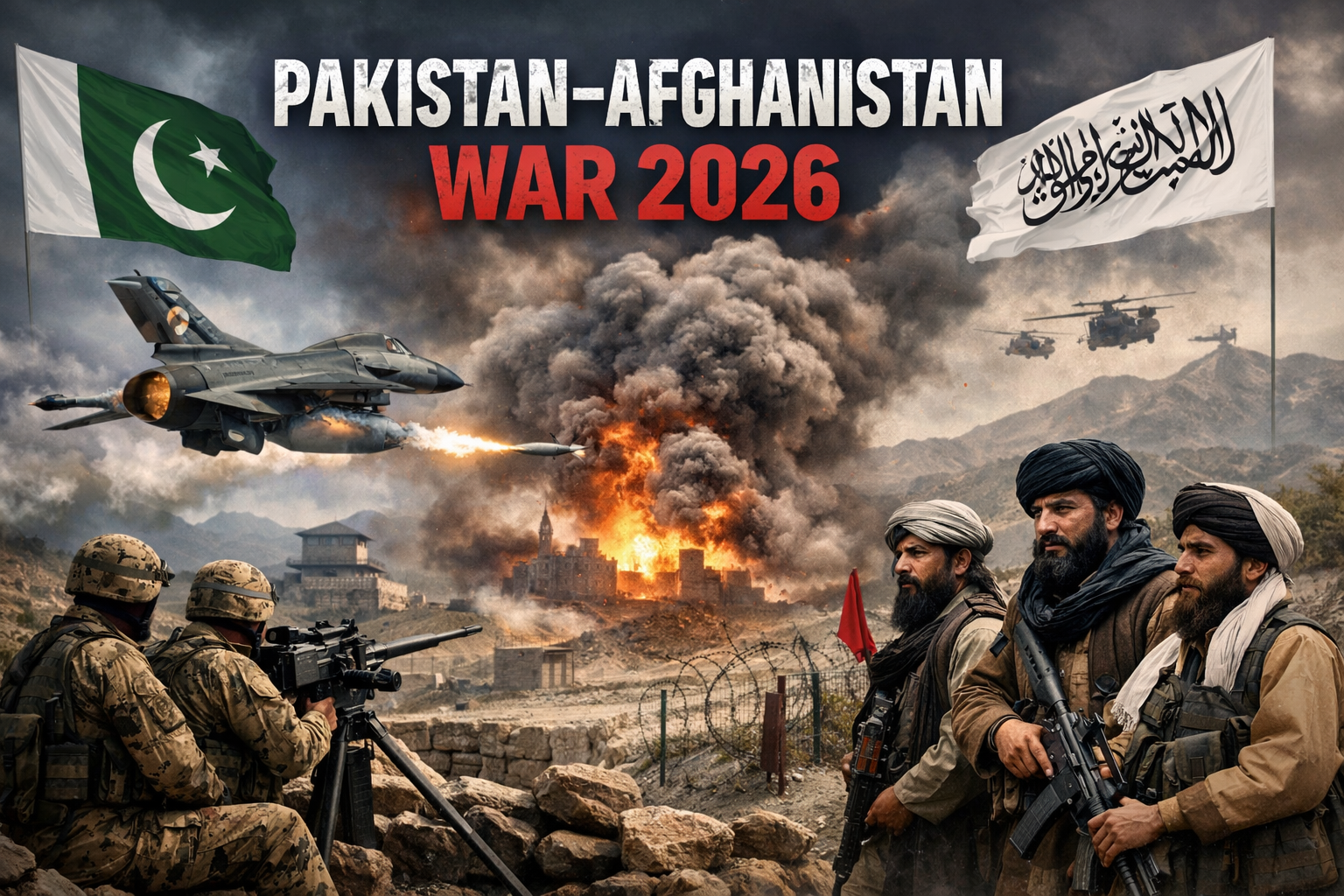
People often search for “Pakistan–Afghanistan war” expecting a formally declared, conventional conflict with clear front lines. The current crisis looks different. It blends cross-border strikes, border-post battles, and disputes over armed groups operating in the frontier region. Leaders also use sharper language than in many previous flare-ups, which raises the stakes for diplomacy and deterrence.
In late February 2026, senior Pakistani officials described the confrontation as “open war,” while Taliban officials in Afghanistan said Pakistan struck targets in multiple locations, including Kabul and Kandahar. Those claims arrived alongside reports of retaliatory attacks and escalating clashes along the border. The situation remains fluid, and independent verification of casualty figures remains difficult during active fighting.
What happened in February 2026
On February 27, 2026, reporting described Pakistan carrying out air and ground strikes inside Afghanistan after days of hostilities that included border clashes and Afghan retaliatory actions. Taliban officials said strikes hit or affected major population centers, and images and eyewitness accounts suggested damage and emergency activity in Kabul. Pakistan, for its part, framed its actions as responses to attacks and as part of efforts to address threats linked to militancy.
Pakistan’s defense minister publicly used the phrase “open war,” signaling that Islamabad viewed the escalation as more than a routine border incident. Pakistan’s foreign ministry also warned that future provocations or attacks by “terrorist” groups would draw a measured but decisive response. Such statements matter because they reduce room for quiet de-escalation and raise expectations for follow-through at home.
At the same time, Taliban officials indicated they would prefer talks to contain the crisis, even as fighting continued. That posture reflects a familiar dynamic in this relationship. Both sides often push hard in public while leaving space for intermediaries to explore a ceasefire, especially when trade disruptions and domestic anxiety rise quickly.
Why “war” does not look like a full-scale invasion
This conflict does not resemble a conventional invasion with sustained territorial pushes and stable front lines. It looks like a high-intensity escalation cycle that concentrates firepower around border corridors, military posts, and alleged militant sites. Each side tries to impose costs while avoiding a move that would trigger a larger regional crisis.
That structure creates its own kind of danger. Short, sharp clashes can still spiral if leaders misread intent or if a strike causes large civilian casualties. When both sides expect retaliation, they tend to interpret even defensive moves as offensive signals, which accelerates escalation.
The core dispute: militancy and cross-border attacks
Pakistan’s central allegation focuses on militant groups that it says operate from Afghan territory and attack Pakistani targets. Pakistani officials frequently point to the Tehreek-e-Taliban Pakistan (TTP), often called the Pakistani Taliban, as a key threat. Afghanistan’s Taliban government denies it provides sanctuary and often argues that Pakistan should address its own security and governance challenges instead of assigning blame.
That dispute becomes hard to resolve because it combines intelligence claims, sovereign territory, and domestic politics. Pakistan wants visible, verifiable action against networks it blames for attacks. The Taliban resists steps that could fracture its own coalition or appear to subordinate Afghan decision-making to Pakistan.
The border itself fuels conflict: geography and friction points
Pakistan and Afghanistan share a long, rugged frontier that cuts through mountains and tribal regions. That terrain complicates policing, surveillance, and border demarcation, and it makes it easier for armed actors to move and hide. It also places civilian communities close to potential flashpoints, which means even limited clashes can cause displacement and disruption.
Officials and analysts often mention the border’s length because it underscores the scale of the problem. Reporting described the frontier as roughly 2,600 kilometers (about 1,615 miles), which helps explain why leaders struggle to “seal” the border even with fencing and checkpoints.
The Durand Line: a historic boundary that still triggers modern conflict
The Afghanistan–Pakistan border is widely known as the Durand Line, created through an 1893 agreement that set spheres of influence during the colonial era. The line runs about 1,600 miles (2,600 kilometers) and functions today as the international land border between the two countries. History matters here because the border split Pashtun communities and left a legacy of political sensitivity, identity questions, and competing narratives.
Many Afghan leaders across different eras have treated the Durand Line as contested or politically uncomfortable, even when practical cooperation demanded border management. Pakistan treats it as a settled international boundary that it must secure. This mismatch creates recurring disputes over fencing, construction near the line, and the location of border posts.
When a border disagreement coincides with a militant attack, escalation becomes more likely. Each government can frame the clash as defense of sovereignty rather than a negotiable incident. That framing tightens the political constraints leaders face when they consider a ceasefire.
Border crossings and trade: economics as pressure and leverage
Conflict at the border does not just involve soldiers. It directly affects trade routes that connect Afghanistan’s landlocked economy to Pakistani ports and markets. When crossings close, supplies slow down, prices rise, and truck backlogs grow quickly.
One major pressure point involves the Torkham crossing, a key route for goods and travelers. Earlier reporting in this broader conflict cycle described closures and clashes linked to disputes over border construction and management, with trucks stranded and commerce disrupted. While each closure may start as a security measure, the economic cost can quickly push leaders toward either talks or further coercion.
Trade pressure often works in both directions. Pakistan can tighten movement and apply economic leverage, while Afghanistan can look for alternatives through other neighbors, even though it often pays more and moves slower. Both options carry political costs, so each government tends to treat crossings as bargaining tools during crises.
Refugees and deportations add fuel to the relationship
Pakistan has hosted large Afghan refugee populations for decades, and recent years have seen sharper policy shifts and large-scale returns. These decisions have real humanitarian consequences, but they also shape the politics of the conflict. Pakistani officials often link migration issues to security screening and internal stability, while Afghan officials and aid groups emphasize legal protections and the strain on Afghanistan’s already fragile economy.
Refugee policy can also affect diplomacy in a very direct way. When families face uncertainty about legal status, work, and housing, public sentiment hardens and leaders feel less able to compromise. That dynamic increases friction during the exact moments when both sides need calm messaging.
How escalation happens: the retaliation loop
A typical escalation cycle begins with an attack that one side attributes to militants operating across the border. The targeted side responds with strikes or raids, aiming to deter future attacks and show resolve. The other side then frames the response as a violation of sovereignty and retaliates along border posts or with its own strikes.
Public messaging accelerates the loop. When officials describe the crisis in maximal terms, they increase expectations for further action and reduce the political space for backchannel diplomacy. Even if leaders want to pause, they often fear that restraint will look like weakness.
The February 2026 cycle shows the pattern clearly. Reports described retaliatory attacks, intensifying clashes, and subsequent strikes inside Afghanistan alongside increasingly severe public language.
Military balance and what it means for strategy
Pakistan fields a stronger conventional military than Taliban-run Afghanistan, including more advanced air and strike capabilities. That imbalance gives Pakistan options for rapid cross-border operations, especially when it believes it has actionable intelligence. At the same time, strike capability does not guarantee strategic success, because it can produce civilian harm, generate backlash, and harden opposition.
Afghanistan’s Taliban forces do not match Pakistan’s conventional strength, but they bring long experience with guerrilla conflict and deep local knowledge in border provinces. That combination can impose persistent costs through raids, harassment of posts, and the ability to blend into difficult terrain. For that reason, Pakistan may seek short, sharp actions rather than long campaigns, while the Taliban may seek to endure and retaliate in ways that preserve internal cohesion.
Civilian impact: why limited clashes still cause major harm
Civilians feel the costs first, especially in border districts where communities sit close to posts, roads, and crossing points. Fighting can trigger sudden displacement, school closures, and interruptions to basic services. Even when strikes target alleged militant sites, proximity to population centers can create fear and disruption far beyond the immediate blast zone.
In February 2026, reporting and imagery from Kabul suggested emergency responses and visible damage after claimed strikes. Even without complete casualty verification, such incidents can drive lasting political anger and deepen mistrust.
The economic impact can compound humanitarian stress. Border closures can disrupt food supply chains, reduce day wages for transport workers, and increase prices for staple goods. In Afghanistan, where many households already struggle with poverty, even short disruptions can create acute hardship.
Diplomatic efforts: ceasefires can work, but they often do not last
Recent history shows that mediation can stop shooting quickly when both sides want a pause. In October 2025, talks in Doha produced an immediate ceasefire after intense border clashes, with Qatar and Turkey playing mediating roles. The ceasefire reduced violence, but it did not resolve the underlying dispute over militancy and cross-border attacks.
Follow-up negotiations can also break down quickly when the parties disagree on enforcement and verification. Reporting later in 2025 described failed efforts to reach a longer-term arrangement after the Doha ceasefire, with each side blaming the other for the lack of progress. That pattern suggests that ceasefires treat symptoms faster than they address causes.
In February 2026, the Taliban signaled openness to talks again, which may provide another off-ramp if intermediaries re-engage. Still, the “open war” framing and reported strikes on major cities create a tougher political environment for compromise. Leaders may feel they must show results before they can sell a pause to domestic audiences.
Regional and international responses
International actors often prioritize containment rather than choosing sides, because wider instability can threaten trade routes, refugee flows, and counterterrorism priorities. External diplomacy can also provide face-saving pathways, such as agreeing to technical border mechanisms or establishing incident hotlines. Mediation efforts in 2025 demonstrated that third parties can help when both capitals want a pause.
At the same time, outside actors rarely control the core dispute. Any durable arrangement must address the militant safe-haven question and the mechanics of border management. Without those elements, ceasefires tend to freeze conflict temporarily while the underlying drivers remain intact.
What comes next: four realistic scenarios
A short spike followed by a ceasefire remains plausible. Both sides may decide that the economic and humanitarian costs outweigh the gains from continued fighting, especially if border closures harm commerce. In that case, talks may restart quickly, and both sides may adopt language that allows them to claim deterrence and restraint at the same time.
A prolonged border conflict also remains possible. That scenario would feature recurring clashes, intermittent strikes, and long or repeated closure of key crossings. Neither side would “win” decisively, but both might continue to impose costs to avoid looking weak.
A more durable framework could emerge if mediators help the parties agree on verifiable steps. Pakistan would likely seek concrete action against groups it blames for attacks, along with border rules that limit construction disputes and firefights. The Taliban would likely seek guarantees about sovereignty, limits on cross-border strikes, and economic normalization through predictable border operations.
A wider regional spillover poses the highest risk, even if it remains less likely than the first three scenarios. Escalation could intensify if a high-casualty attack occurs, if strikes hit sensitive sites, or if internal political crises in either country reduce leaders’ willingness to compromise. Militants can exploit chaos in that environment, which can further degrade security and trust.
What to watch over the next few weeks
Watch the status of major crossings such as Torkham and Chaman, because reopening often signals willingness to de-escalate. Track diplomatic travel and mediation activity, because it can indicate whether the parties are building an off-ramp. Pay attention to changes in official language, especially if leaders begin to specify red lines, timelines, or explicit war aims.
Also watch for any verifiable steps linked to the militant dispute. If Pakistan points to specific arrests, relocations, or restrictions, it may try to justify a pause. If the Taliban offers structured border mechanisms and denies sanctuary with accompanying enforcement steps, it may try to reduce the rationale for strikes while preserving sovereignty.
FAQ: common questions about the Pakistan–Afghanistan war
People ask whether this is a “real war” or “just border clashes.” The crisis includes cross-border strikes and official language that elevates the severity of the confrontation. At the same time, it still operates as an escalation cycle rather than a sustained conventional invasion, which makes it dangerous in a different way.
People also ask why the Durand Line matters today. The Durand Line’s history shapes modern politics, because it created a border that split communities and carries contested meaning in national narratives. That legacy makes fencing, posts, and construction disputes far more than technical arguments.
Many readers ask whether diplomacy can work. Diplomacy can stop violence quickly, as the 2025 Doha ceasefire showed, but it tends to fail when the parties cannot agree on enforcement and on the militant safe-haven question. A lasting deal would likely require verification mechanisms and crisis communication channels that survive public anger.
Sources
I based this article on recent reporting about the February 2026 escalation and the 2025 ceasefire cycle, and on background references that explain the Durand Line’s origins and length.