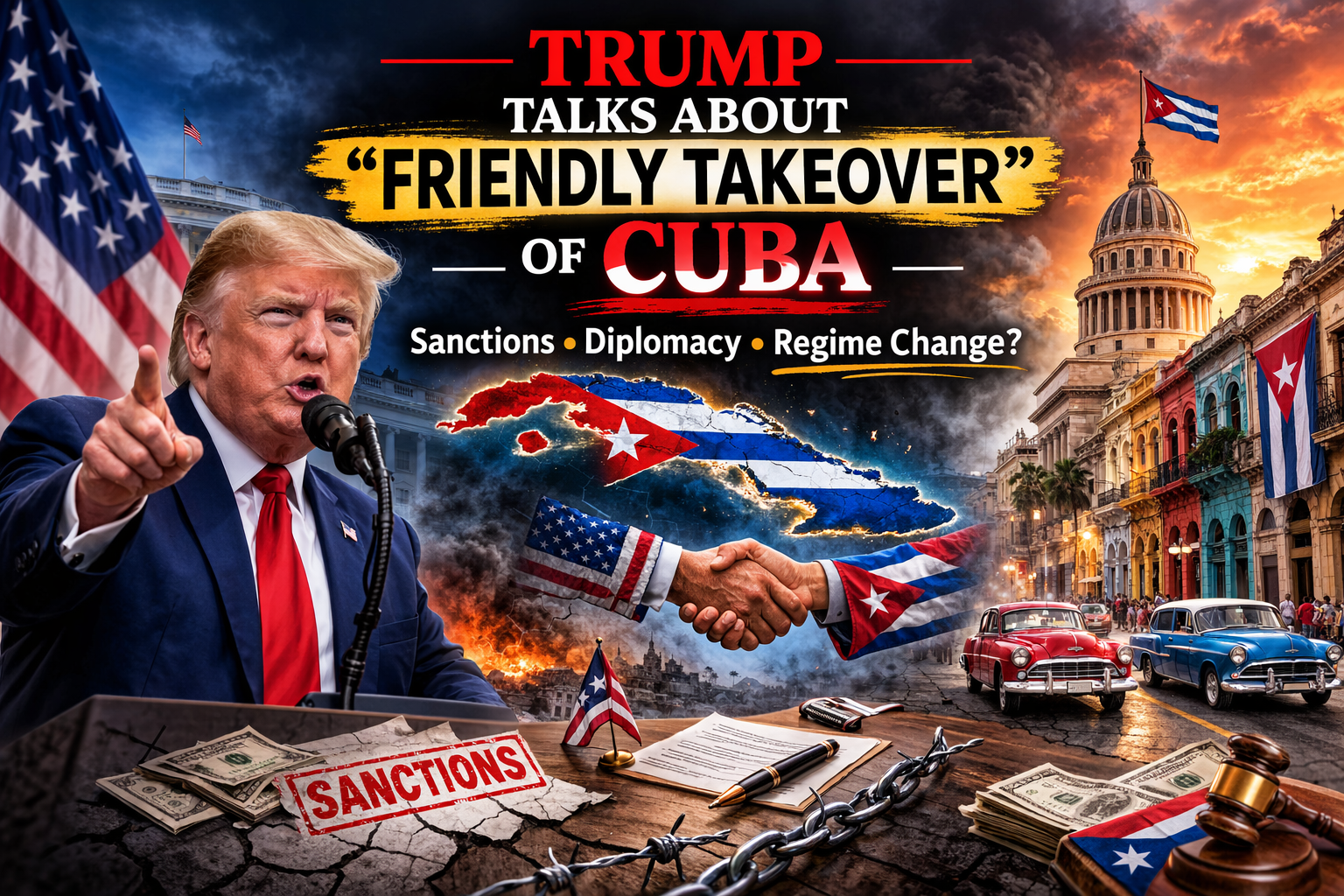
President Donald Trump sparked a new round of debate about U.S.-Cuba relations on February 27, 2026, when he told reporters he could see a “friendly takeover of Cuba” emerging from talks with Havana.
Trump offered no definition for the phrase, and the White House did not provide immediate clarification. Even so, the remark landed in the middle of a rapidly shifting regional picture: Washington has increased pressure on Cuba’s government in recent weeks while Cuba faces a worsening fuel and electricity crunch tied to tighter sanctions and new tariff threats that target third-country oil suppliers.
This article breaks down what Trump said, the context behind the comment, the competing interpretations of “friendly takeover,” and the practical legal and diplomatic limits that shape what the United States can do next.
What Trump said about a “friendly takeover of Cuba”
Trump made the comments as he left the White House for a trip to Texas, according to multiple reports. He described Cuba as a country “in a big deal of trouble” and said the Cuban government has talked with U.S. officials.
He then introduced the phrase that drove headlines: he suggested the United States might “have a friendly takeover of Cuba,” and he repeated the idea without spelling out any concrete plan, timeline, or negotiating terms.
Reuters reported that Trump tied the comment to Secretary of State Marco Rubio’s involvement, saying Rubio dealt with Cuba talks “at a very high level.” The Associated Press similarly reported Trump’s claim about high-level discussions and emphasized that Trump did not explain what “friendly takeover” would entail.
Cuba’s response and the dispute over “high-level talks”
A key question sits at the center of the story: do formal, high-level negotiations between Washington and Havana actually exist?
Reuters reported that Cuban officials have said they do not participate in high-level talks with the United States, even as reporting has circulated about informal outreach involving figures tied to Cuba’s leadership.
Earlier in February, the Associated Press also described Cuban President Miguel Díaz-Canel’s public denial of current talks with the U.S. government beyond technical contacts in the migration area. That gap between Trump’s framing and Havana’s public posture leaves outside observers with limited verified detail about what, if anything, runs through official channels.
At the same time, AP reported Cuba confirmed communications with U.S. officials after a violent incident off Cuba’s coast that Cuba attributed to a Florida-registered speedboat carrying armed Cubans from the United States. That fact matters because it suggests at least some working-level contact even when both governments downplay the broader relationship.
The pressure campaign backdrop: oil, tariffs, and a deepening energy crisis
Trump’s “friendly takeover” comment did not arrive in a vacuum. It followed weeks of escalating U.S. economic pressure focused heavily on fuel.
On January 29, 2026, the White House published an executive order that declared a national emergency with respect to Cuba and created a mechanism to impose additional ad valorem duties on imports from countries that “directly or indirectly” sell or provide oil to Cuba. The order assigns major roles to the Commerce Department (to determine which countries supply oil to Cuba) and the State Department (to recommend tariff levels and implementation).
The Associated Press described the measure as an escalation that could increase pressure on Mexico in particular, given Mexico’s role as an oil lifeline for Cuba in recent years.
Reuters later reported that Mexican officials explored ways to send fuel to Cuba without triggering U.S. tariff reprisals, while also trying to avoid a humanitarian spiral on the island. Reuters also reported Cuba relies on imported fuel for a large share of its energy needs and has struggled with long gas lines and worsening power outages.
Taken together, those developments help explain why Trump framed Cuba as a country “in deep trouble” and why any talk of U.S. “help” quickly turns into a debate about leverage, concessions, and sovereignty.
What does “friendly takeover” even mean?
“Friendly takeover” comes from business and finance, where it describes an acquisition that management supports rather than fights. Governments do not conduct mergers, and international law does not recognize a “takeover” of a sovereign state as a normal instrument of policy.
So when Trump uses the phrase, analysts and diplomats typically interpret it as political shorthand rather than a literal blueprint. The most plausible interpretations fall into a few buckets, each with different implications.
1) A negotiated political transition, framed as cooperative
In this scenario, the U.S. government tries to trade economic relief for political or economic reforms in Cuba, then markets the outcome as a “friendly” change of direction rather than a coercive outcome.
That approach could include steps like targeted sanctions relief, energy carve-outs, or licensing changes, paired with Cuban commitments on elections, prisoner releases, property claims, private enterprise rules, or migration enforcement. Trump did not outline any such agenda publicly on February 27, so this remains an inference rather than a confirmed plan.
2) A rhetorical label for maximum pressure that produces regime change without an invasion
AP reported that Trump has argued in recent weeks that Cuba’s weakened economy might collapse without the oil shipments that previously arrived from allies, suggesting he might not need military action to force political change.
Under this interpretation, “friendly takeover” functions as branding: the U.S. increases economic pressure until Cuban leaders negotiate from a position of weakness, then Washington calls the outcome “friendly” because it avoids overt armed conflict.
3) Limited cooperation that expands U.S. influence without formal “control”
A third interpretation treats the phrase as a loosely defined promise of increased U.S. influence: more direct involvement in energy stabilization, ports, telecom, migration enforcement, or security coordination. That kind of involvement can grow quickly during crisis response, especially if a government requests external help.
Again, Trump did not give operational details, so observers cannot confirm whether his team aims for something as narrow as crisis coordination or something as sweeping as political restructuring.
4) Messaging to domestic audiences, including Cuban-American voters
U.S. policy toward Cuba often overlaps with domestic politics, especially in states with large Cuban and Cuban-American communities. AP reported Trump referenced exile communities and suggested something “very positive” could come for people who left Cuba, though he did not elaborate.
That makes “friendly takeover” potentially as much a political signal as a diplomatic proposal.
Legal and diplomatic constraints that shape what the U.S. can do
Even if Trump wanted to translate the phrase into policy, he would face real limits from U.S. law and international law.
International law: sovereignty and the UN Charter
The UN Charter obligates member states to refrain from the threat or use of force against the territorial integrity or political independence of any state. That framework does not ban diplomacy, sanctions, or conditional aid in general, but it sharply constrains any plan that implies coercive annexation or military seizure of governance.
Because Trump used a phrase that sounds territorial, critics immediately connect it to sovereignty concerns. Supporters may argue he meant a peaceful, negotiated outcome, but his team would still need to clarify how any arrangement respects Cuban self-determination under international norms.
U.S. law: Congress holds major power over the embargo
U.S. sanctions policy toward Cuba includes layers of statute and regulation. In practice, presidents can adjust parts of Cuba policy through executive action, licensing, and enforcement choices, but Congress has codified major aspects of the embargo and related restrictions through legislation such as the Helms-Burton (LIBERTAD) Act.
Government and historical references describe how Helms-Burton strengthened and formalized embargo authorities and linked changes to political conditions in Cuba, including the concept of a “transition government” as a benchmark in U.S. policy frameworks.
That reality matters for any “deal” scenario: even if Cuba offered concessions, Trump would still need to navigate Congress for any durable, sweeping rollback of embargo-era restrictions.
Third-country pressure creates spillover risks
Trump’s January 2026 executive order targets countries that provide oil to Cuba through tariffs on their exports to the U.S., which can quickly turn Cuba policy into a broader trade and diplomacy problem.
AP reported that Cuban officials condemned that approach as coercive, while Mexico has tried to balance humanitarian concerns with tariff threats. As third parties adjust behavior, the island’s fuel crunch can deepen regardless of whether Washington and Havana talk directly.
Why the fuel crisis sits at the center of the current standoff
Fuel shapes nearly every part of Cuba’s day-to-day stability: electricity generation, transportation, refrigeration, water pumping, and hospital operations. Reuters reported Cuba imports fuel for a substantial share of its energy needs, and shortages have driven long lines and outages.
That makes fuel both a humanitarian issue and a bargaining chip. U.S. officials can frame pressure as a way to force political change; Cuban officials can frame it as collective punishment; humanitarian groups often argue for carve-outs to protect civilians regardless of politics.
AP reported that civil society organizations urged Congress to push the administration to reverse aggressive policy and warned that efforts to cut oil shipments could trigger humanitarian collapse. Cuba’s deputy foreign minister also criticized the continuing fuel squeeze in a social media post that he later deleted, according to AP.
Those competing frames set the stage for the next phase: either negotiations that trade relief for concessions, or further escalation that increases migration pressure and regional instability.
How the UN and global opinion fit into the story
International criticism of U.S. Cuba policy often runs through the UN General Assembly’s annual vote on the embargo. In October 2025, UN reporting described another overwhelming call to end the U.S. economic embargo on Cuba. Reuters and AP have both covered those votes as politically significant but non-binding.
That backdrop matters because Trump’s new tariff mechanism extends pressure beyond U.S.-Cuba relations and into third-country trade, which can amplify diplomatic pushback even among countries that criticize Cuba’s governance.
Scenarios to watch over the next few weeks
Trump’s remark created more questions than answers, but the policy landscape suggests several near-term paths.
Scenario A: Quiet talks expand, with limited confidence-building steps
If the two governments maintain technical contact—especially around migration or security incidents—Washington and Havana could add limited confidence-building steps such as information sharing, maritime coordination, or narrowly tailored humanitarian licensing. AP reported U.S. agencies have investigated aspects of the recent maritime incident, which provides one plausible channel for ongoing communication.
Scenario B: Pressure intensifies through oil enforcement and third-country tariffs
If the administration focuses on tightening the oil squeeze, Mexico and other suppliers may continue looking for workarounds, and Cuba may face sharper shortages. Reuters reported Mexican officials have already explored ways to send fuel without triggering U.S. tariff punishment.
Scenario C: A broader bargain emerges, but Congress limits how far it goes
Even if negotiators reach understandings, statutory constraints can limit large-scale embargo rollback. References to Helms-Burton’s codification and its transition-government framework illustrate why major shifts often require congressional action or at least sustained political alignment.
Scenario D: Messaging escalates without clear policy follow-through
Trump has used attention-grabbing language before, and leaders sometimes float maximal positions to shape headlines or strengthen bargaining posture. Because Trump has not provided a definition or a plan, this scenario remains plausible until the administration releases clearer guidance.
Key questions readers ask about Trump’s “friendly takeover” comment
Did Trump announce a specific plan?
No. Reuters and AP both reported he did not provide details about what a “friendly takeover” would involve.
Is Cuba actually negotiating with the U.S. “at a very high level”?
Trump said yes, but Reuters reported Cuba has denied high-level talks, and AP has reported Cuban leadership denying negotiations beyond technical migration contact in other recent contexts.
Does U.S. law allow a quick end to the embargo as part of a deal?
Presidents can adjust some policy levers, but statutory frameworks like Helms-Burton limit sweeping changes without congressional involvement or satisfaction of conditions tied to political transition benchmarks.
Could this lead to military action?
Trump did not threaten an invasion in the February 27 remarks reported by Reuters and AP, and international law heavily constrains the use of force against another state’s territorial integrity. Still, rhetoric can raise fear and uncertainty, especially during periods of economic stress and security incidents.
Bottom line: big rhetoric, limited verified details
Trump’s “friendly takeover” line added an unusually blunt phrase to an already tense moment in U.S.-Cuba relations. He described Cuba as desperate and said U.S. officials have talked with Cuban leaders, but he offered no concrete definition for what he meant.
Meanwhile, U.S. policy has already moved in a measurable way: the January 2026 executive order created a tariff mechanism aimed at cutting off oil flows to Cuba by pressuring third-country suppliers. That policy—combined with ongoing disputes over talks, humanitarian concerns, and legal constraints—will likely shape what happens next far more than a single phrase.