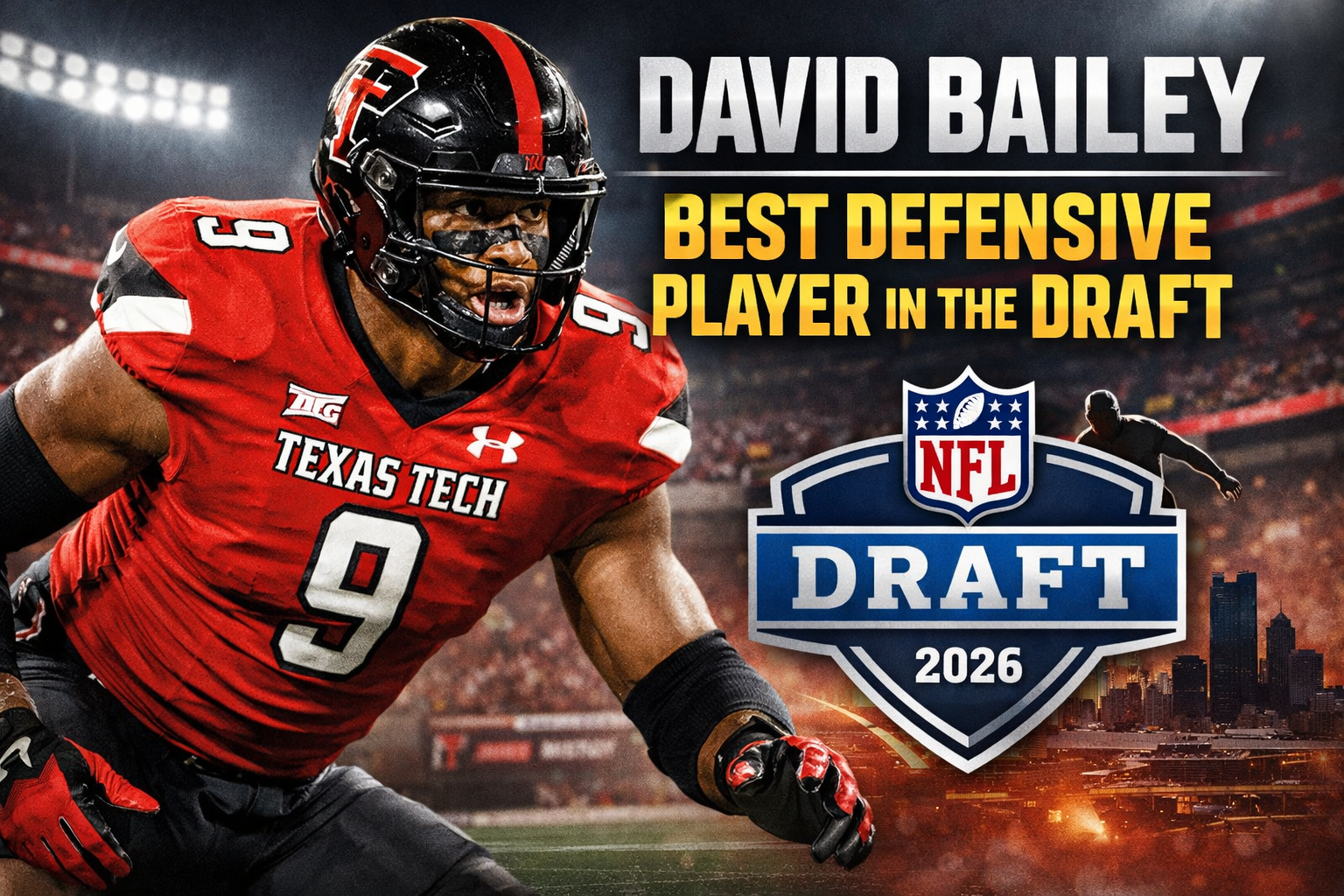
Every draft cycle produces a handful of defenders who can change how an offense calls a game. In the 2026 NFL Draft, Texas Tech edge rusher David Bailey has built the clearest “tilt the protection, speed up the quarterback, win you third down” profile in the class. He checks the two boxes evaluators chase most: dominant disruption on Saturdays and athletic traits that translate on Sundays.
That does not mean every team will place him as the No. 1 defender on its board. Some clubs will prioritize a rare coverage player, a true eraser corner, or a do-everything safety. Others will rank interior defensive line above edge based on roster structure. Still, when you weigh positional value, week-to-week impact, and projection to the NFL, Bailey offers the strongest overall argument to lead the defensive class—because pass rush still drives defensive efficiency in the modern league.
The 2026 NFL Draft runs April 23–25 in Pittsburgh, and the NFL Scouting Combine runs Feb. 23–March 2 in Indianapolis, which puts Bailey’s testing and interviews under the brightest spotlight of the pre-draft process.
Who David Bailey Is and Why Evaluators Keep Coming Back to Him
Bailey entered the national draft conversation as more than “another productive edge.” He arrived at Texas Tech as a high-profile transfer and immediately turned the Red Raiders’ front into a matchup problem. ESPN’s early 2026 draft rankings described him as the nation’s most impactful defensive transfer, highlighting his first-step quickness, hand usage, and relentless pursuit while also crediting him with FBS-leading sack production during the regular season.
Texas Tech’s own program recap frames his season in even broader terms: the staff notes that Bailey finished as the nation’s highest-graded defensive player in Pro Football Focus grading (93.3 overall), logged 623 defensive snaps, and produced 81 total pressures by PFF’s charting.
Even if you treat any single metric with caution, the combined story stays consistent: Bailey did not just “get sacks.” He created pressure at a volume that forces offenses to adjust protections, shorten drops, and call quick-game concepts earlier than they want to.
The Production Profile: Disruption That Shows Up Everywhere
When scouts debate the top defensive player in a draft, they usually start with three questions:
- Can he consistently affect the quarterback?
- Can he do it against NFL-caliber tackles and schemes?
- Can he do it without needing perfect circumstances?
Bailey answers the first question with overwhelming evidence. Texas Tech credits him with top-tier pressure production and elite grading across a full workload, not a situational role.
He also answers the second question indirectly through context. Texas Tech’s defense turned into one of the defining units of the 2025 college season, and the Red Raiders’ front became the engine. An Associated Press report on Texas Tech’s combine presence pointed to the transfer-heavy defensive line as a major driver behind a breakthrough season that included the program’s first Big 12 crown and first College Football Playoff appearance.
And Bailey answers the third question by showing he can win in multiple ways. ESPN’s scouting blurb emphasizes his burst plus leverage and hands—translation: he does not rely on a single speed rush.
That combination matters because NFL tackles punish one-dimensional rushers. When a player pairs an explosive get-off with counters, he forces the tackle to “play honest,” and that creates opportunities for the rest of the front.
Athletic Testing: The Combine Confirmed the Tools
Dominant college production can still leave open questions: “Does the athlete match the tape?” Bailey’s early combine numbers helped close that gap.
CBS Sports’ combine tracker listed Bailey’s official measurements at 6’3½” and 251 pounds, with 10¼” hands, 33⅝” arms, and a 79⅝” wingspan.
Those numbers matter for a few reasons:
- Length: Arm length does not guarantee a pass rush plan, but it helps finish moves, keep separation, and control the tackle’s chest. Bailey clears common thresholds teams use for edge prospects.
- Mass: 251 pounds fits the modern edge range where a defender can rush wide, reduce inside on passing downs, and still anchor enough on early downs in many fronts.
- Explosiveness: CBS’ tracker also listed a 35-inch vertical and 10’9″ broad jump for Bailey, which supports the first-step burst that shows up on tape.
Then came the headline number: the 40.
Sporting News’ live tracker listed Bailey with a 4.51-second 40-yard dash, the fastest among the edge rushers recorded in that update.
CBS’ live combine blog also noted Bailey clocking an unofficial 4.51 on his first run.
For an edge defender in the 250-pound range, that speed changes how teams project his usage. It supports a role as:
- a wide-9 stressor who can win the corner,
- a stunt/loop piece who can threaten interior gaps with real closing speed,
- a QB spy option against athletic passers in certain game plans,
- a backside pursuit defender who can erase boot concepts and stretch runs.
The league keeps paying for that kind of athlete because quarterbacks keep extending plays, and offenses keep forcing defenses to cover longer.
Why “Best Defensive Player” Often Starts With “Best Pass Rusher”
A simple reality shapes draft boards: edge rushers sit among the NFL’s highest-paid positions because they influence every snap. CBS Sports summarized the modern premium position groups as quarterbacks, edge rushers, wide receivers, and offensive tackles—then used that framework to explain why even a special safety like Caleb Downs would represent an exception if he goes top 10.
That framework supports Bailey’s case. If you can draft a defender who:
- creates pressure without blitz help,
- forces protection slides,
- generates negative plays,
- and closes games in two-minute situations,
you gain a structural advantage. You also reduce how often you need to expose your secondary to high-risk pressure calls.
Bailey’s production and testing align with that premium value, which makes it easier for teams to justify him as the top defensive prospect even if another defender offers a cleaner “all-around” profile.
How Bailey Wins: Traits That Translate to Sundays
Evaluators do not draft sacks. They draft repeatable wins. Bailey’s profile points to several NFL-friendly traits:
First-step acceleration and timing
The get-off drives everything. ESPN specifically called out his first step as a problem for tackles.
Combine explosiveness numbers (vertical/broad) reinforce that burst.
Hands, leverage, and counters
Speed rushers flame out when tackles overset and ride them past the pocket. Bailey’s scouting notes emphasize leverage and strong hands, which suggests he can punish oversets with inside counters and keep his rush path efficient.
Motor and pursuit
Plays that do not “belong” to an edge rusher often separate the top tier—backside runs, scramble drills, broken protections, extended plays. ESPN highlighted his relentless pursuit as a core feature of his profile.
Workload and endurance
Texas Tech credited Bailey with 623 snaps and elite grading across that volume. A full workload matters because teams worry about “designated pass rushers” who disappear on early downs.
The Biggest Competition: Other Defenders With Real “No. 1” Arguments
Bailey’s strongest challengers tend to fall into two buckets: “unusual coverage impact” and “rare body type.”
Caleb Downs, S, Ohio State: the coverage-plus-tackle outlier
CBS Sports laid out why Downs can break the usual positional value rules. The piece notes that Downs could become the first safety drafted in the top 10 in nearly a decade, and it cites a rare production mix across his college career: 257 tackles, 16 TFL, and 6 interceptions while also earning the Jim Thorpe Award for top defensive back in 2025.
Downs brings a legitimate “best defender in the class” résumé. If a team values versatility and coverage impact above pass rush, it can rank Downs first without forcing the board.
CJ Allen, LB, Georgia: modern MIKE traits
ESPN’s rankings describe Allen as an ideal middle linebacker for modern schemes, emphasizing his processing and ability to flow to the ball, and even drawing stylistic comparisons to Roquan Smith.
A linebacker who can run the defense, fit the run, and hold up in coverage can anchor a unit for years—but teams typically require truly rare traits to take that player above a premium edge.
Matayo Uiagalelei, EDGE, Oregon: size and power upside
PFF’s edge rankings described Uiagalelei as a powerful 6’5″, 270-pound defender with long arms and an NFL defensive end frame, while also noting areas he needs to refine (like bend and stiffness).
Uiagalelei can push for top edge status if a team wants a bigger body with a different projection arc.
Rueben Bain Jr., EDGE, Miami: production with measurement questions
CBS’ combine measurement section highlighted Bain’s shorter arm length and how certain teams might factor that into thresholds.
Bain’s film and production can still win teams over, but length conversations often shape early-round debates.
In other words, Bailey does not win by default. He wins because he combines premium position value with elite production, confirmed athleticism, and fewer structural questions than most of his peers.
Where Bailey Fits Best in the NFL
Teams can deploy Bailey in multiple fronts, but his value rises when a coordinator lets him attack:
4–3 front (wide alignments, pin-your-ears-back rush)
Bailey can stress tackles with speed and force chips from tight ends and backs. That help can simplify coverage behind him because offenses have fewer eligible receivers in routes.
3–4 front (stand-up edge with subpackage flexibility)
At ~251 pounds, he fits the modern outside linebacker mold. Teams can drop him occasionally to disguise pressures, but they should treat that as a constraint breaker, not his core job.
NASCAR packages and pass-down creativity
The “best” NFL rushers often win the subpackage snap counts that matter most: third-and-long and late-game situations. Bailey’s testing speed and burst support creative alignment, including reduced splits inside where he can attack guards.
Texas Tech’s season review also framed him as a “potential top-10 pick,” which aligns with the way teams typically treat multi-tool edge disruptors.
The Risks: What Could Keep Him From the No. 1 Defender Spot?
Even top edge prospects carry legitimate questions. For Bailey, teams will likely focus on four areas:
Run defense consistency
Every pass rusher must prove he can set an edge with technique, leverage, and play strength. If a team views him as more valuable on passing downs than early downs, it could rank a more “complete” defender higher.
Counter development against NFL tackle sets
College tackles often struggle to match a first-step athlete. NFL tackles adjust quickly. Bailey will need to keep sharpening his counters so he can win when tackles overset and when offenses throw chips at him.
Translation of college pressure production
Pressure totals vary across charting sources and game cutoffs. ESPN cited 62 pressures and 12.5 sacks at a regular-season point in time, while Texas Tech cited 81 total pressures and a broader season wrap.
Teams will triangulate with their own charting and isolate “NFL-style” wins.
Draft board philosophy
Some teams build around coverage first and treat pass rush as a scheme product. Others do the opposite. That single organizational preference can change who they call “best.”
The Bottom Line: Why Bailey Still Owns the Strongest Overall Argument
If you define “best defensive player” as “most likely to create immediate and sustained defensive value at an expensive position,” Bailey’s résumé lines up cleanly:
- Elite disruption across a full workload, with top-end grading and pressure volume noted by his program.
- High placement among top overall prospects on major boards, with specific praise for burst, hands, and pursuit.
- Confirmed NFL-caliber tools through combine measurements and explosive testing.
- High-end speed for his size, highlighted in live combine tracking.
Caleb Downs can absolutely challenge him on a pure “best football player on defense” argument, and a handful of other defenders will win specific scheme debates. But when teams step onto the clock and ask, “Who changes our defense the fastest?” they often land on the edge rusher who can win one-on-one and collapse the pocket.
Bailey gives them that answer, and he gives it with fewer projection leaps than most of the class.