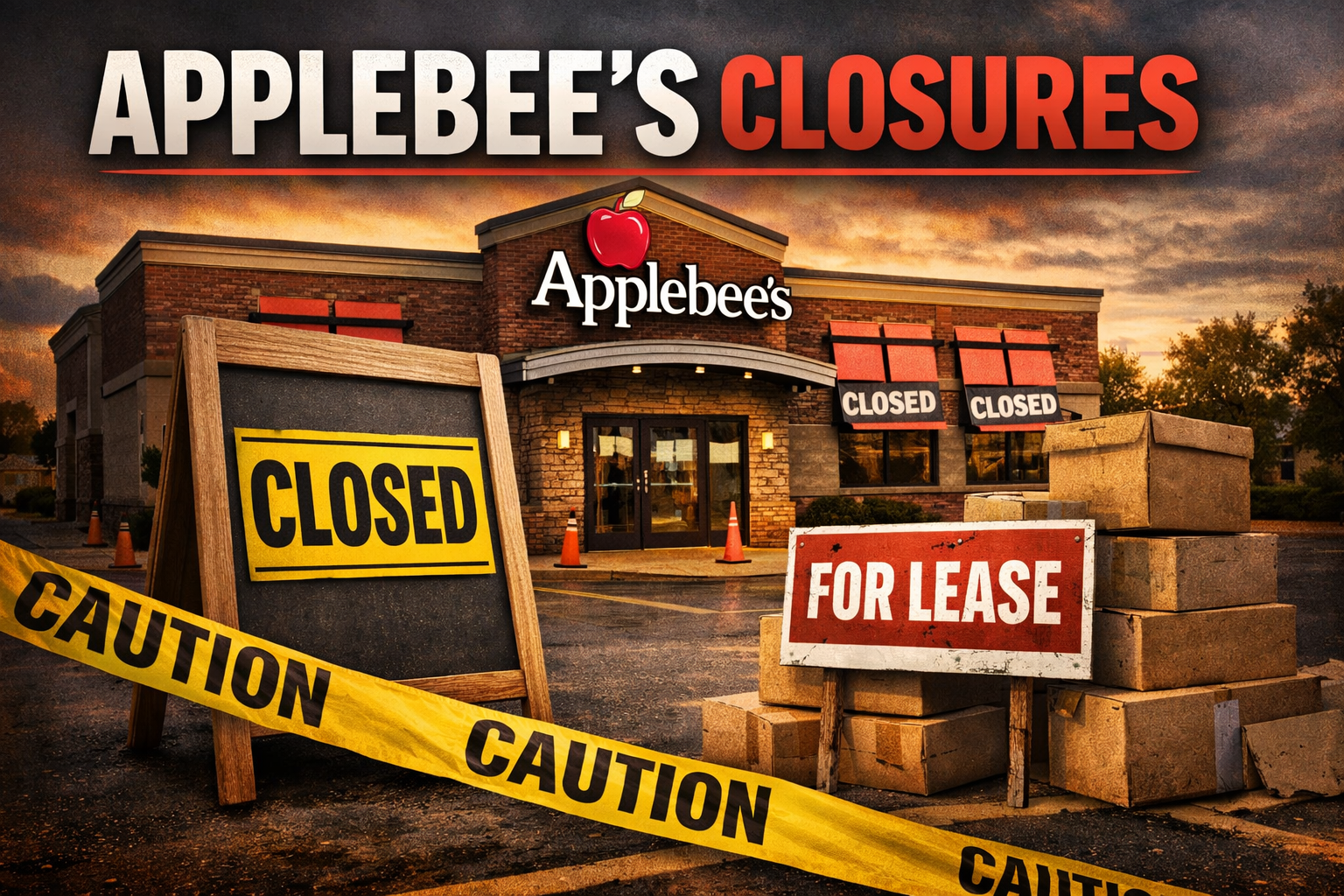
Applebee’s closures have become a recurring topic in restaurant news.
That does not mean the brand is disappearing.
It does mean the chain continues to trim weaker locations while it tries to improve traffic, value perception, and franchise economics.
As of February 24, 2026, the most important thing to know is this: Dine Brands Global, Applebee’s parent company, is set to report its Q4 2025 results on February 25, 2026. That report may update the latest closure and unit-count picture.
So, any article published before that date should treat the 2025 story as in progress.
This article explains the Applebee’s closure trend in plain language.
It also separates headlines from the actual data.
That matters because many stories mix up three very different things:
- permanent restaurant closures
- franchise restaurants sold back to the company
- net unit declines after openings and closures
Those are not the same event.
And if you lump them together, the Applebee’s situation can look worse or more sudden than it is.
Applebee’s is still a large chain
Applebee’s remains one of the biggest casual dining brands in the U.S.
Dine Brands said its three brands, including Applebee’s, had more than 3,500 restaurants across 19 international markets as of December 31, 2024.
That scale matters.
Large chains often close underperforming locations every year.
They also open, relocate, remodel, or convert units.
Closures alone do not prove a brand-wide collapse.
But they can signal pressure.
In Applebee’s case, the pressure is real.
The company’s Q4 2024 release showed Applebee’s domestic comparable same-restaurant sales declined 4.7% in that quarter. Dine also described a “dynamic operating environment” and outlined a 2025 plan focused on refreshing and reinforcing its brands.
That combination usually points to a chain in active turnaround mode.
The 2024 baseline set the tone
The 2024 numbers shaped the Applebee’s closure conversation.
In Dine Brands’ Q4 and full-year 2024 results, the company said Applebee’s and IHOP franchisees together recorded 65 openings and 83 closures in 2024.
That figure covers two brands, not Applebee’s alone.
Still, it helped fuel headlines about restaurant downsizing.
Dine also introduced 2025 guidance that called for Applebee’s domestic development activity to be between 20 and 35 net fewer restaurants.
That line matters more than a generic “closures” headline.
It shows management expected Applebee’s U.S. footprint to shrink again in 2025 on a net basis.
In other words, the brand entered 2025 already expecting more pruning.
What the latest reported Applebee’s numbers show
Before Dine reports Q4 2025, the latest detailed Applebee’s unit data in public releases comes from the company’s Q3 2025 results.
Those figures show Applebee’s remained large, but smaller than a year earlier.
For the nine months ended September 30, 2025, Dine’s restaurant development table for Applebee’s showed:
- 4 franchise openings (2 domestic, 2 international)
- 47 franchise closures (38 domestic, 9 international)
- 43 net franchise restaurant reduction before company acquisitions
- 12 Applebee’s franchise restaurants acquired by the company
- 55 net decrease in franchise restaurants after those acquisitions
- 1,571 total Applebee’s restaurants at period end
- 1,465 domestic Applebee’s restaurants at period end
That table gives a much better picture than viral posts do.
It shows closures.
It also shows ownership changes.
And it shows that some “lost” franchise units became company-owned units instead of disappearing.
Why “franchise count down” does not always mean “restaurant closed”
This point causes a lot of confusion.
In 2025, Dine disclosed that it acquired Applebee’s franchise restaurants, including 12 in the first half of the year. The company’s releases also note earlier acquisitions, such as 47 Applebee’s restaurants acquired in late 2024.
When that happens, the franchise count drops.
But the restaurant may still operate.
It just moves from a franchisee’s books to Dine’s company-owned bucket.
That means a headline based only on franchise totals can overstate actual closures.
You need the development table.
You also need the end-of-period total restaurant count.
Dine’s disclosures provide both.
The Applebee’s footprint has trended down
Even after accounting for ownership shifts, Applebee’s total count declined.
Dine’s Q4 2024 release showed 1,614 total Applebee’s restaurants at year-end 2024, including 1,501 domestic units.
Dine’s Q3 2025 release showed 1,571 total Applebee’s restaurants and 1,465 domestic units at September 30, 2025.
That means, by the end of Q3 2025, Applebee’s had:
- 43 fewer total restaurants than at the end of 2024
- 36 fewer domestic restaurants than at the end of 2024
That is a meaningful reduction.
It also matches the company’s earlier guidance that expected net domestic shrinkage in 2025.
The pace of closures can look uneven quarter to quarter
Another point often gets lost.
Closures do not happen in a smooth monthly pattern.
Lease timing drives many decisions.
So does franchisee health.
So do local remodel choices and sales trends.
Dine’s Applebee’s development tables show that 2025 closure activity came in waves.
For example, in the first half of 2025, Applebee’s disclosed 42 franchise closures on a year-to-date basis, including 34 domestic and 8 international, with only 1 opening in the same six-month period.
By the end of Q3 2025, the nine-month total rose to 47 franchise closures and 4 openings. That implies a lighter closure count in Q3 itself than in the first half.
That pattern does not erase the decline.
But it shows why “Applebee’s is suddenly shutting down everywhere” can mislead readers.
The process looks more like ongoing optimization than one single event.
Why Applebee’s closes locations
Applebee’s closures usually stem from a mix of business factors.
No single reason explains every shutdown.
Here are the main drivers.
1) Underperforming unit economics
If a restaurant cannot generate enough cash, it becomes a closure candidate.
That can happen for several reasons:
- low traffic
- weak lunch business
- local competition
- poor visibility
- outdated layout
- high occupancy costs
Casual dining chains rely on volume.
When traffic slips, margins tighten fast.
2) Franchisee financial pressure
Applebee’s operates mostly through franchisees.
That model helps the brand scale.
It also means unit decisions often happen at the franchisee level.
A franchisee may close stores because of debt, rent resets, labor shortages, or local cost spikes.
Dine’s risk disclosures in its earnings release also flag franchisee financial health as an important factor for the business.
3) Shifts in consumer value expectations
Restaurant guests still dine out.
But many households remain price-sensitive.
The National Restaurant Association’s recent industry outlook described cautious optimism for 2026 while also emphasizing consumer budget limits and cost pressure across the sector.
That environment can hurt mid-tier casual dining locations that sit in tougher trade areas.
Consumers compare every meal more aggressively.
They trade down more often.
They also respond strongly to clear value offers.
4) Real estate and lease decisions
Some closures happen when leases expire.
Operators may decide not to renew if the site no longer makes sense.
This decision can reflect:
- rent increases
- poor parking
- trade area changes
- lower traffic after nearby development changes
- better returns from a nearby replacement site
These closures can happen even when the brand still wants a presence in that market.
5) Portfolio cleanup during a turnaround
Turnarounds usually involve hard choices.
Chains cut weak stores to protect brand averages and improve franchisee returns.
Applebee’s appears to fit that pattern.
Dine has discussed plans tied to value, brand refresh efforts, and development strategy while also guiding for net fewer domestic Applebee’s restaurants.
That combination points to selective contraction, not random retreat.
Why some Applebee’s closures get more attention than they should
Applebee’s is a familiar brand.
Many communities have strong memories tied to it.
So a single closure can spread fast online.
Then people assume a nationwide collapse.
That reaction makes sense emotionally.
It does not always match the data.
Three things amplify the noise.
First, local TV and local news sites publish closure stories quickly.
Second, social media posts often skip the franchise context.
Third, roundups mix Applebee’s with other restaurant chains facing very different problems.
The result creates a “domino effect” narrative.
But Applebee’s trends need their own analysis.
Dine’s reported numbers show a shrinking footprint.
They do not show a sudden company-wide shutdown plan.
The turnaround angle: closures on one side, reinvestment on the other
Closures tell one part of the story.
Reinvestment tells the other.
Dine’s 2025 messaging stressed brand refresh work and value positioning, and outside trade reporting highlighted remodel and dual-brand efforts as key pieces of the Applebee’s plan.
That matters because chains often pair closures with a growth reset.
The logic looks like this:
- close weaker standalone sites
- improve top-performing units
- push remodels
- expand formats with better economics
- focus franchise development in stronger markets
Dine’s disclosures also point to dual-brand Applebee’s/IHOP activity as part of the broader development conversation. The company’s Q3 2025 release notes dual-branded restaurant counts in its reporting notes.
So, “closures” and “growth strategy” can happen at the same time.
They often do.
What investors and operators usually watch next
When people ask about Applebee’s closures, they usually want a simple yes-or-no answer.
The better question is this:
Are closures accelerating, stabilizing, or slowing relative to management’s plan?
To answer that, watch these items.
Net domestic Applebee’s unit change
This gives the clearest footprint trend.
Dine already guided for 20 to 35 net fewer domestic Applebee’s restaurants in 2025.
When Q4 2025 results arrive, compare the actual result to that range.
Gross openings versus gross closures
Net counts can hide progress.
A chain may improve development quality even while total units fall.
Dine’s tables show this split clearly.
Comparable sales and traffic direction
Store closures matter, but sales momentum matters too.
If sales improve at retained stores, closures can slow later.
If sales stay weak, more pruning may follow.
Dine’s Q4 2024 release showed pressure in Applebee’s comps at that time, which helped frame the 2025 outlook.
Franchisee health and refranchising or acquisitions
Dine’s recent disclosures show restaurant ownership shifts, not just closures.
That can change how the footprint evolves.
A restaurant might leave a franchisee’s portfolio and continue operating.
What this means for customers
If you are a customer, the closure story feels personal.
You care about your local Applebee’s.
You do not care much about national averages.
That makes sense.
Still, national data helps you interpret local news.
A local closure does not automatically mean your region will lose every Applebee’s.
It may mean:
- one weak store closed
- a lease ended
- the operator consolidated nearby units
- the site may reopen under another concept
- the company or franchisee may reinvest in a stronger location
On the other hand, if several nearby Applebee’s close in a short period, that can reflect real local market strain.
Both things can be true.
What this means for franchisees and landlords
For franchisees, closures can improve a market if they remove weak cannibalizing units.
They can also raise concern if traffic declines spread across the area.
For landlords, Applebee’s closures can create short-term vacancy risk.
But they can also create redevelopable restaurant boxes.
Many former casual dining sites attract other users because they already have kitchen infrastructure, parking, and visibility.
That real-estate reality explains why chains sometimes exit a site faster than consumers expect.
The building still carries value.
What the data says right now, in one paragraph
Here is the short version.
Dine Brands entered 2025 expecting Applebee’s domestic units to decline on a net basis by 20 to 35 restaurants.
By September 30, 2025, Dine’s reported Applebee’s data showed 47 franchise closures year to date, 4 franchise openings, 12 franchise units acquired by the company, and an ending count of 1,571 total Applebee’s restaurants, including 1,465 domestic units.
That confirms a real contraction trend.
It also confirms that some headline “losses” came from ownership shifts, not only permanent closures.
Final takeaway
Applebee’s closures are real.
They also need context.
The brand still operates a large system.
But its footprint has been shrinking, and Dine’s own guidance and reported unit counts support that conclusion.
At the same time, the closure story does not equal a total brand collapse.
Dine’s disclosures show a more complicated picture that includes franchise closures, company acquisitions of franchise stores, and efforts to improve the business through value and development strategy.
The next major checkpoint is clear.
Dine scheduled its Q4 2025 earnings release for February 25, 2026. That report should show whether Applebee’s 2025 closures landed near the low end, middle, or high end of management’s earlier range.