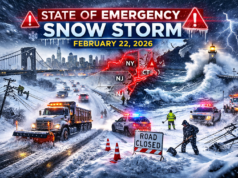
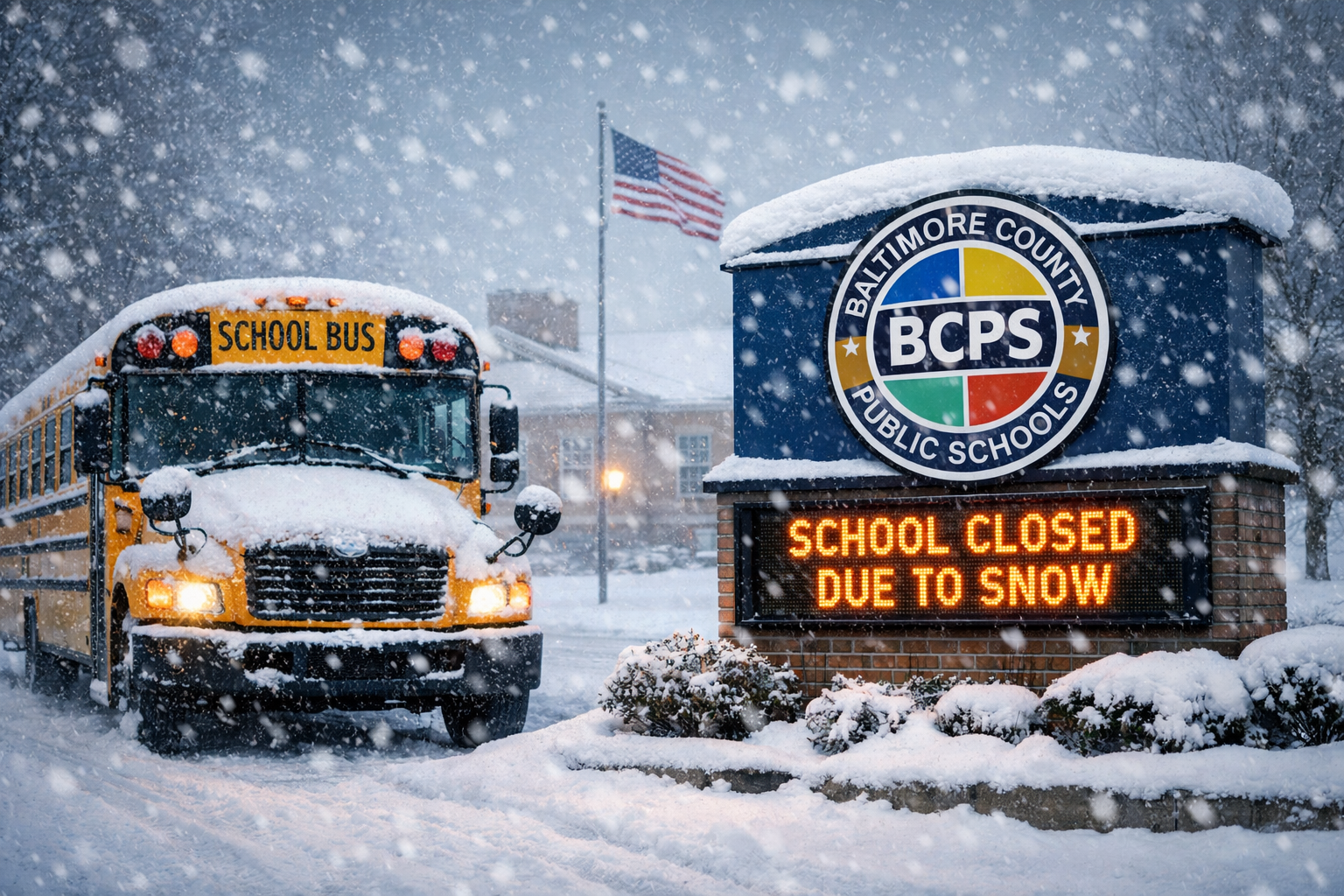
A winter storm affecting Maryland on February 22–23, 2026 put school systems across the region into “weather decision mode,” including Baltimore County Public Schools (BCPS)—a district serving about 108,017 students as of its official 2025 enrollment count.
For families, students, and staff, the immediate question is simple: Will schools open normally, open late, move to virtual learning, or close? The reality is more complex. Snow isn’t just a forecast number—it’s road temperatures, timing, wind, visibility, and how conditions differ from one part of the county to another. And because BCPS runs countywide transportation, schedules, and building operations at scale, decisions need to be made early, communicated clearly, and executed consistently.
This article explains what’s known about the storm setup, how BCPS makes closure/delay decisions, how BCPS’s virtual-inclement plan works in 2025–2026, and what practical steps families can take when winter weather hits.
The storm snapshot: what forecasters expected for Baltimore-area conditions
The National Weather Service (NWS) issued a Winter Storm Warning for the Baltimore area with a window running from 3:00 PM EST February 22 to 10:00 AM EST February 23.
In the NWS Baltimore forecast, the Sunday-night period was flagged as the most disruptive: precipitation shifting toward snow with new snow accumulation of roughly 3 to 5 inches possible, plus gusty winds.
Local and regional outlets also emphasized variability—where some neighborhoods get a few inches while others get significantly more depending on where heavier bands set up. The Washington Post’s Capital Weather Gang described the potential for narrow corridors of intense snowfall, with some locations possibly exceeding 6 inches if they sit under a persistent band.
Zooming out, the storm was part of a broader East Coast winter weather event with blizzard warnings and major travel disruption in multiple states. AP reported blizzard alerts and warnings spanning communities from Maryland to Massachusetts, with the NWS warning that 1 to 2 feet of snow was possible in many areas farther north and east.
For Baltimore County and BCPS operations, the key takeaway is that timing matters. Snow arriving overnight can still cause morning hazards: reduced visibility, untreated or re-frozen roads, and difficult conditions at bus stops, school driveways, and sidewalks.
Why Baltimore County school decisions can be hard to “predict” from a single snowfall number
Baltimore County spans dense suburban corridors, waterfront areas, and higher-elevation pockets. That geographic spread matters because winter storms often produce:
- Different precipitation types across short distances (rain/snow mix vs. all snow)
- Different accumulation depending on elevation and banding
- Different road conditions based on traffic volume, salting schedules, and pavement temperature
Even within the Baltimore metro, forecasts can diverge. For example, CBS Baltimore cited a central/northern Maryland forecast of 5 to 7 inches (with higher totals possible in some areas), while also noting Baltimore itself might see 1 to 3 inches, with higher totals possible north and west of the Beltway in higher elevations.
That range is exactly why school leaders focus on more than totals. A “3-inch” storm can be manageable if it falls midday and melts fast—or highly disruptive if it falls overnight, blows around, and turns to ice at dawn.
For BCPS, this becomes a transportation and safety math problem: thousands of bus stops, walking routes, school lots, and staff commutes, all needing to be safe enough to run on time.
How BCPS decides closings, delays, and early dismissals
BCPS publishes a detailed overview of how it makes weather decisions. The system’s stated “main factor” is safety, and it describes using multiple data points before deciding to close or delay.
BCPS says it gathers information from sources such as:
- Hourly weather updates (including AccuWeather and other sources)
- Early-morning road checks: as early as 2:30 a.m., transportation staff patrol county roads, bus stops, and known problem areas
- Input from agencies including Maryland State Police and the Baltimore County highways department
- Site-level conditions: sidewalks, walking routes, driveways, bus loops, and parking lots
- Coordination with county transportation officials and nearby school systems
BCPS also highlights the operational complexity of any weather decision—altering bus schedules, adjusting staffing, notifying families, and informing media—then notes that if schools are closed for the day, an announcement is typically made by 5:30 a.m.
This is why families sometimes see other districts announce decisions earlier while BCPS holds longer: the system describes a process designed to reflect real road and site conditions, not just a forecast map.
How BCPS communicates snow decisions
BCPS directs families to multiple channels for updates, including:
- The BCPS website (home page emergency announcements)
- BCPS TV and local radio/television stations
In a January 22, 2026 message to the community, BCPS also said weather-related operating updates would be posted on the BCPS website and social media platforms and sent by email to staff and families.
When storms evolve quickly, the best practice is to treat these as “official sources of record,” and treat third-party closing lists as helpful but secondary—especially when different lists update at different speeds.
BCPS’s 2025–2026 approach: virtual instruction after three traditional closure days
BCPS’s winter-weather planning in 2025–2026 includes a major operational shift: after three full-day inclement weather closures, BCPS’s plan is to transition to virtual instruction days when weather would otherwise force additional closures.
BCPS has emphasized this plan in multiple communications:
- In a December 1, 2025 update, BCPS said it would transition to virtual school days after three closures, and that students would be reminded to bring devices/chargers home when inclement weather is forecast.
- On the BCPS “Virtual Instruction Days” page, the district notes that these virtual days count toward Maryland’s required instruction and reiterates that families will be notified when BCPS shifts to virtual learning for weather.
- In the January 22, 2026 reminder message, BCPS again told students to plan to bring devices, chargers, and materials home ahead of potential extended closures.
This is an important lens for the February 2026 storm: once the district has used three closure days, the next severe-weather disruption may be handled differently than the classic “snow day.”
What a BCPS virtual inclement-weather day can look like
BCPS’s Virtual Instruction Days guidance includes several operational details that matter to families:
- Instruction begins two hours later than the normal schedule to give students time to log in and get set up
- A minimum of four hours of synchronous instruction
- Teachers take attendance
- There are opportunities for students to make up work if they are unable to connect
BCPS also addresses access and support. On the same page, BCPS states it maintains a 1:1 device ratio for students in Grades 3–12 and has provided wireless hotspots to families who request them (describing this as part of its continuing access approach).
That said, the day-to-day “how” still varies by school and classroom: which platform is used for meetings, how assignments are posted, and how small-group help is delivered. BCPS notes that individual schools may communicate specific scheduling information for programs and classes.
For students, the practical implication is that a virtual snow day is not automatically “free time.” It’s closer to a modified school day with a later start and a structured minimum amount of live instruction.
What happened earlier this winter: January closures and the shift to virtual learning
BCPS’s February 2026 messaging indicates the district had already lived through a significant winter disruption earlier in the season.
In a February 5, 2026 staff and community update, BCPS said:
- Schools and offices were closed January 26–28, 2026
- BCPS transitioned to virtual learning January 29 and 30
This matters for two reasons.
First, it shows the plan wasn’t theoretical—it was used during the 2025–2026 winter season.
Second, it implies that additional closures later in the season could push the district into more virtual instruction days (depending on how BCPS counts and applies “traditional inclement weather days” under its plan). The key point for families is that “snow day expectations” are no longer one-size-fits-all across the school year.
How the February 22–23 storm affected school-closure chatter across Maryland
While BCPS decisions must be taken from BCPS channels, it’s still useful to understand the broader ecosystem BCPS operates within.
Local outlets reported that many Maryland districts began announcing delays or closures for Monday, February 23. WBAL, for example, reported closures for Cecil and Harford counties and delays for Carroll and Howard counties as announcements started rolling in.
WMAR published a list of early announcements including closures and virtual instruction decisions by other districts, emphasizing uncertainty in expected snowfall totals.
At the state level, Maryland Gov. Wes Moore issued a State of Preparedness ahead of the storm, citing the likelihood of hazardous travel and potential impacts to roads and transportation centers.
The pattern here is typical: some districts commit early based on forecast confidence, while others wait for updated observations and road checks. BCPS’s own published process suggests it weighs both forecast data and early-morning ground truth from transportation staff.
Academic and family impact: snow days vs. virtual days
Winter disruptions create two very different kinds of “missed time”:
- Traditional closure days: no instruction, but also no attendance requirements
- Virtual inclement days: instruction continues, but access, logistics, and supervision can be difficult for families
A January 2026 FOX45 story captured a range of parent and student reactions to closures and virtual learning—some worried about how long it takes students to get back on pace after missed days, while a pediatric psychologist emphasized that many children are resilient and benefit from structure even during disruptions.
That framing aligns with what many educators suggest in practice: during disruptions, what helps most is predictable routines, clear expectations, and a short list of “must-do” tasks.
For BCPS families, this means planning for both possibilities:
- If BCPS closes fully, the priority becomes safety and basic routines.
- If BCPS shifts to virtual, the priority becomes “school readiness at home”: charged devices, a quiet spot (if possible), and knowing how to log in.
Safety and logistics: what matters most for BCPS operations
BCPS repeatedly emphasizes that it weighs conditions affecting:
- Walking routes and sidewalks
- Bus stops and known problem road areas
- School driveways, bus loops, and parking lots
This is also why wind can be as important as snowfall. The NWS forecast highlighted gusty winds during the warning window, and broader regional coverage emphasized that snow plus wind can reduce visibility and create hazardous travel.
Local safety guidance during storms often centers on limiting travel, preparing for outages, and using heat sources safely. CBS Baltimore’s winter-storm preparedness coverage included reminders about staying informed, avoiding unnecessary driving, and preparing basics in case of outages.
For BCPS families, safety decisions are often about the “micro moments”:
- Is the bus stop plowed or icy?
- Can a student safely walk to school entrances?
- Are staff able to reach buildings?
- Can buses safely run neighborhood routes without getting stuck or sliding?
Those questions don’t always correlate perfectly with the number on a snowfall map.
Practical checklists for BCPS families during snow events
If snow is forecast for a school night
- Charge devices and locate chargers (and headphones if used for class).
- Make sure students know how to access BCPS learning platforms (BCPS notes Schoology access resources on its virtual instruction page).
- Review where BCPS announcements are posted (BCPS website and local media).
- Set expectations: “We’ll know by early morning” is consistent with BCPS’s guidance that closure announcements are typically made by 5:30 a.m. when closing for the day.
If BCPS announces a virtual inclement weather day
- Remember BCPS states instruction begins two hours later than the normal schedule on virtual inclement days.
- Have a “startup routine”: log in, check messages/assignments, confirm where to join live sessions.
- If internet is unreliable, document what happened and connect with the school when possible; BCPS notes opportunities for students to make up work if they’re unable to connect.
- Keep the day structured—meals and breaks at predictable times can help students stay regulated and focused.
If BCPS closes fully
- Prioritize safety first and keep an eye on updated forecasts and warnings.
- Keep a light academic routine if helpful (reading, practice problems, or catching up on assignments), but avoid turning the day into a “punishment schedule.”
- If students rely on school meals, remember BCPS states it provides free breakfast and lunch to all students districtwide under the Community Eligibility Provision during normal operations.
(For closures/virtual days, meal distribution details—if any—are typically communicated separately by the district or individual schools.)
Bottom line
For the February 22–23, 2026 storm window, the NWS Winter Storm Warning timing and accumulation expectations made it the kind of event that can plausibly trigger delayed openings, closures, or a shift to virtual instruction—especially given overnight impacts and the wide variability that can occur across a large county.
BCPS’s published approach emphasizes safety, early-morning road checks, and the operational realities of moving a 111,000-student system.
The most useful strategy for families is to plan for two paths at once: “classic snow day” logistics and “virtual learning day” logistics—because BCPS’s 2025–2026 plan is designed to use both depending on how many closure days have already been used and what conditions demand.